Showing posts with label social networks. Show all posts
Ready or Not Player One
Sunday, June 22, 2014
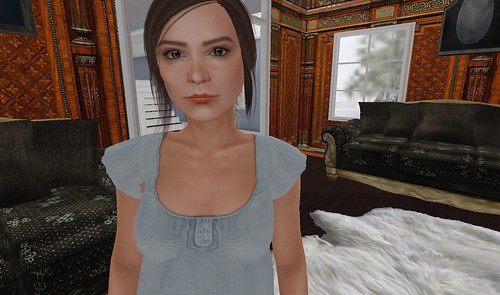
Above is my current avatar standing in one of the patches of land that I rent. At the time it was taken, this SL visit was just like any other day. Little did I know that a few days later I, and other SL players, would discover that Second Life is basically over. And not over by any other company than its parent company Linden Lab. Due to a planned or unplanned leak, Linden Lab has confirmed that it is building another virtual world.
At first I was excited. Second Life needs a great many quality of life upgrades which are mostly out of reach due to the age of the platform. A new place with better avatar tools would be great. But as I came down from my high, other more logical questions started to surface.
Mainly about land. The land market is now essentially dead and that is a little frightening. Because Second Life's revenue stream is land. Prokofy Neva wrote a great post about it from the rental business viewpoint. This could potentially be a fiasco that could be a bigger than the Zindra shakeup a few years back. Ebbe Linden answered a few basic questions on Sluniverse.com regarding the new world. He mentioned that they were thinking about lowering land costs in favor of item taxation. A concept which I thought was strange. Does the lab think that they can make more from adding fees to creators and buyers? Did they have an accountant look into this? Or is this another pie in the sky idea from some insane ideology that Silicon Valley people love to worship?
How will LL plan to deal with all the landholders, including myself, who are now holding the bag for worthless land that costs a monthly fee? Granted I only hold almost a quarter of mainland. Not a lot compared to people like Anshe Chung, Prokofy Neva, etc. but it is still a big investment compared to most single users in the world. This isn't including the land I rent from themed estates that I love such as Winterfell and 1920's Berlin. I admit I spend much more on land in Second Life than I should. But I look at it as an entertainment expense on par with going to the movies. When all is said and done, I would spend the same amount attending the local movie house. But I get more joy from Second Life than I've ever received from passive film watching.
Will there even be land, as we know it, in the new place? Already people on sluniverse are screaming for no setup fees or tier fees. They are campaigning for bubbles (like the failed Cloud Party) that will disappear when their users are not logged into the world. So there will be no world, no places to visit, and no homes or landscaping to admire. That would be a deal breaker for me. I simply would not move over but stay in old SL until the lights go out.
According to Ciaran Laval's site, he pointed out a Linden post on sluniverse that Second Life isn't on par with World of Warcraft but more like the old Everquest. Which just flabbergasts me. Why is an employee of the company downplaying the success of the company's core product? What possibly good could that do in the public image? This indicates to me that LL, as well as the rest of the VR tech community, are still beguiled by the Snowcrash/Ready Player One fantasies. Fantasies that have been shown time and time again to be just fantasies. WoW didn't get made with fantasies that there were about 10 million people out there waiting to play its game. They were hoping for old Everquest success of a few hundred thousand to a million people. That they attracted more was an outlier. So developing the next VR with the idea that millions of people will pile on is laughable. Especially when it has been proved that only a small number of people feel comfortable with the avatar experience and an even smaller who are capable of self directed play time.
Recently there was a news story which stated that children who don't learn their letters through penmenship (just by typing or tracing letters on a computer pad) are not forming the same neural connections as people who did learn their alphabet by writing. Technology is literally changing the human brain. And I'm beginning to suspect that this has a large bearing on Virtual Worlds. Mainly because the audience for a free form virtual world that only LL offers (SL) has an audience that skews older. The known, guaranteed audience for virtual worlds are old as in old enough to have gone through the schooling system before new technology. This is something that must be taken into account and in fact should worry virtual world creators. If this is the case (as it appears to be) their audience is old and getting older with no one to replace their numbers. I speak from experience. I'm in middle age and getting older than that soon, I love SL but my young niece was wary of it. All the people who grew up in new technology either gravitate to on the rail games or just hang out in Facebook like interfaces but mainly text message/twitter. Twittering, by its very nature, doesn't encourage exploration, it doesn't encourage deep thinking. What it does encourage is burp like exclamations about lunch and bathroom habits. That is not the kind of thinking that takes well to virtual world experiences.
Despite warning signs, I really hope that it will be Linden Lab that creates the next popular platform. Mainly because I'm more comfortable with the devil you know over the devil you don't idea. Linden Lab does like doing things its own way but it also has consistently changed its direction due to public feedback. Granted many changes were due to outcry but at least things got changed. Worlds don't get made without protest or the ability to protest. Unfortunately the fascistic turn that real world and the tech world are experiencing actively discourages protest. Where will that leave us?
Right now, we are left in a holding pattern. Land will become a lot cheaper as people dump their holdings in preparation for the new place. But I don't see much of this land being purchased. Who would want to buy something that will not carry over to the new place? I'm at the max of the tier I can pay, I should probably dump what I have but I can't do it. Not yet. I already came to the conclusion that I will not recoup my expenditures. Not only will the land market suffer but I see people holding back on home purchases such as housing and landscaping. Maybe fashion will be able to hold up. But really why spend loads of money on things that will not transfer. This is worrying because by all accounts the new place will not even be ready for another two years.
Whatever the case someone's goose is being cooked. Just whose it is, is not clear.
Monday, May 13, 2013
Jaron Lanier's book "You are Not a Gadget" was so revolutionary and clear headed in its critique of internet culture or really, lack of culture. In fact, Lanier presented evidence that the internet was actively destroying culture.
His main argument was that cultural music, films, photos, television shows were being decontextualized from their time period, mixed and mashed into meaningless bits. Our cultural heritage, both high art and pop, were being ground into meaninglessness. In turn, new ideas were being subjected to the same grindstone so that nothing new was taking hold. The music of the 1960's and 1970's into the 1980's had a distinct sound. But everything past the 1990's, when the internet culture took hold, is generic and rehashed.
In essence our culture has frozen in time. We are in stasis.
Unfortunately, Lanier's amazing book did nothing to wake anyone up from their dreams. The Internet class is still spouting off the decayed and contaminated mantra of the opensource web. While unable to see that it destroys IT jobs and benefits only the richest few.
Now Lanier is back with a new book that carries on with what he discovered in his last.
He granted an interesting interview with Salon
This time Lanier digs deeper into why the internet and its no culture locust mentality is actively destroying the middle class. His interview reveals that outlier success ventures on Youtube and other social networks are masking the damage being done to the middle class worldwide.
The interview goes into interesting views on the fall of Kodak and that internet success story of Jenna Marbles is built on a mountain of failure and ponzi scheme dynamics.
Anyway the his new book, "Who owns the Future" has my attention and I plan to get my hands on it as soon as possible.
Thursday, March 24, 2011

I just watched a video feed of a conference from Gametech in Orlando via Metanomics in SL.
One of the issues that came up about VRs and their application to the military was regarding price. As in how to make it all less expensive. Particularly in regards to content portability. There was a great concern that they (as in military companies and providers) couldn't take their toys to all ports hither and thither. That they were stuck on proprietary platforms. All of this kind of talk reminded me of a comment once made by Prokofy Neva. That little Second Life was at the epicenter of enormous interest by various parties and it was trying all it could to remain autonomous. That this was most likely one of the main reasons why the company culture was so insular.
This led me to look upon the whole issue of various groups fighting over content, control and platform direction as a battle over a very successful proof of concept venture. Second Life is not a commercial platform. It is an experimental proof of concept to the world that a non-game virtual environment can be done. How well is open to personal opinion. The company is not public it is still under the domain of private capital. As such, it is at the mercy of the various whims and ideologies of it's investors. The investors still look at Second Life as an experimental prototype with it's direction still open to change.
The monkey wrench in all the works are the regular users. As far as we are concerned Second Life is done. We erroneously thought that becoming a social entertainment VR was what Second Life was all about. However all the jabs that Linden Lab made at becoming entertainment have been half hearted. But once again they are trying to give themselves direction as entertainment and as a result hired Rod Humble (an exec with experience in the gaming industry) as the new CEO. Truly everything hinges on whether or not Rod Humble is successful in turning SL into some kind of attraction like a regular mmorpg game. Because if he isn't, I believe Second Life as we know it today will cease to exist.
The military and it's satellite company providers are now very large investors in the Second Life prototype. Recently they purchased the Enterprise platform subdivision of SL. And it is truly no surprise why. Second Life is a reliable and working platform. There would be no need for the US Military to commission it's providers to program a working alternative. Of course since they did spend a lot of money for this variation of the platform, they are looking to cut corners off in other areas. They want their purchase to come with benefits. Benefits such as getting rid of proprietary content restrictions. Its all under that cynical notion that content should be free to move. But what it means is that the military doesn't believe in Second Life as a stand alone company with proprietary rights to it's IP. Now why would they have that opinion?
I think about the track record of the various big names of LL, including Philip Linden, and all of them support the notion that the platform of SL should be like some kind of utility. That it should be a jump off point for some kind of mega grid with free highways to move information. This led me to a deeper understanding why these people hated the notion of land arbitrage and shopkeeper economy in SL. These money making elements depend on proprietary systems. They depend on lawful restrictions to protect property of the guinea pigs who thought Second Life was about them. Meanwhile, we guinea pigs in SL were just an example that the grid was workable. An example to various interested parties that many would do high grade graphic work and accept chump change for payment.
Many of the VC bigwigs of Second Life don't really care if Second Life becomes a big entertainment platform. They just wanted to create a "Snowcrash" world and go down in the history books as the first founders of this mega grid. They already made their billions, so SL's success as a stand alone company wasn't of utmost priority. Now that the military is sniffing around, the same entity that funded and launched the internet itself, this group is getting excited. I have a fear that they will happily throw Second Life users out the window, requisitioning our content to placate the Military complex. Especially if it means it will launch the Snowcrash.
Friday, July 9, 2010
We will still move forward with new forum features such as the ability to rate posts up or down, post highlighting based on rating, improved search functionality, and more. However, when we launch the new StarCraft II forums that include these new features, you will be posting by your StarCraft II Battle.net character name + character code, not your real name. The upgraded World of Warcraft forums with these new features will launch close to the release of Cataclysm, and also will not require your real name.
Mike Morhaim CEO Blizzard Entertainment
This announcement is good news. It shows that we, the people, still have power to influence.
The quick pullback on this odious policy indicates to me that the protest cancellations were large enough to make an impact.
But I think the true reason that broke this camel's back was that Blizzard faced a true "Let them eat Cake" disaster.
On a protest blog, a number of Blizzard employee information was culled by using their real names. Not only that, the information for extended family was revealed as well.
The wife of one Blizzard Exec was documented to have complained on her Facebook about her lack of money to pay for a personal trainer for more than 4 days.
Considering that we are in the thick of a depression, that World of Warcraft is financed by people in dire straits (most likely the one luxury still open to them like the movies were in the 30's), this kind of entitled behavior did not look good. There was just no way to combat that kind of bad press.
However, the ideas behind this policy are still enthralling the tech elites. And its just a test shot in a coming war over our rights online. We will have more battles to face in the future.
Mike Morhaim CEO Blizzard Entertainment
This announcement is good news. It shows that we, the people, still have power to influence.
The quick pullback on this odious policy indicates to me that the protest cancellations were large enough to make an impact.
But I think the true reason that broke this camel's back was that Blizzard faced a true "Let them eat Cake" disaster.
On a protest blog, a number of Blizzard employee information was culled by using their real names. Not only that, the information for extended family was revealed as well.
The wife of one Blizzard Exec was documented to have complained on her Facebook about her lack of money to pay for a personal trainer for more than 4 days.
Considering that we are in the thick of a depression, that World of Warcraft is financed by people in dire straits (most likely the one luxury still open to them like the movies were in the 30's), this kind of entitled behavior did not look good. There was just no way to combat that kind of bad press.
However, the ideas behind this policy are still enthralling the tech elites. And its just a test shot in a coming war over our rights online. We will have more battles to face in the future.
Thursday, March 25, 2010
Prokofy Neva wrote a great post about developer Jane McGonigal's speech at TED.
In this discussion McGonigal gushed about gamers, their love for games, their obsessive game playing strategies and how that energy should be harnessed to change the world.
What McGonigal fails to address is the gang, the posse, the mob witch hunts that all online games encourage. I've seen it in action in various forms all across the web. From the brow beating of people who wanted to debate changes in WoW's game, attacks on bloggers of various subjects that range from politics, finance, fandoms or fashion, to people who suddenly decide that a company is a failure and must disappear (i.e. the attacks on Warhammer Online for example).
McGonigal naively calls this mass behavior, this group on a verge of their "big win"... Urgent Optimism. She wants people in charge to give out quests to this unruly mob in order to fight hunger, poverty, global warming and various other misery windmills of human beings. Throughout our collective history as human beings the one failing we tried to prevent in our collective survival strategies was the formation of mobs. Mobs have no conscious, they have no empathy, they are only driven by extremes of anger, fear and more often, mania. It is awful to state this but our games now encourage mob behavior. Because the collective formation in games don't include basic survival strategies. They are only activities that reward mass mob actions to attack others.
What McGonigal fails to understand or just plain ignores is that mobs cannot be controlled. They are directionless entities prone to violence and will cleave to the appearance of any leader that inspires them. More often than not these "leaders" do not have the best interests of human beings in mind. They are people such as Stalin, Hitler, Manson, Jim Jones, or Torquemada. Those people were very capable of harnessing that Urgent Optimism that McGonigal enthusiastically crows about in her speech.
So what is a more realistic example of McGonigal's Urgent Optimism?
Alexis Pilkington being attacked by faceless mobs on her Facebook page.
This may or may not have been a factor in her decision to commit suicide. But the mob so driven by their Urgent Optimistic mania, kept up their attacks on her even after her death. Obviously they needed to go back and exult in the presence of their big win.
How can people be without empathy for a young girl lost at the beginning of her life?
What McGonigal needs to be enthusiastic about is finding the reason why the internet and it's games fosters, harbors and loves sociopaths. Far from making us more loving of our fellow human beings, the internet is cutting us off from each other. It is turning us all into the "other". It is turning us into "Horde", "Alliance", "Order", "Chaos" etc. And if the chosen enemy's name is highlighted in red, it's dead.
In this discussion McGonigal gushed about gamers, their love for games, their obsessive game playing strategies and how that energy should be harnessed to change the world.
What McGonigal fails to address is the gang, the posse, the mob witch hunts that all online games encourage. I've seen it in action in various forms all across the web. From the brow beating of people who wanted to debate changes in WoW's game, attacks on bloggers of various subjects that range from politics, finance, fandoms or fashion, to people who suddenly decide that a company is a failure and must disappear (i.e. the attacks on Warhammer Online for example).
McGonigal naively calls this mass behavior, this group on a verge of their "big win"... Urgent Optimism. She wants people in charge to give out quests to this unruly mob in order to fight hunger, poverty, global warming and various other misery windmills of human beings. Throughout our collective history as human beings the one failing we tried to prevent in our collective survival strategies was the formation of mobs. Mobs have no conscious, they have no empathy, they are only driven by extremes of anger, fear and more often, mania. It is awful to state this but our games now encourage mob behavior. Because the collective formation in games don't include basic survival strategies. They are only activities that reward mass mob actions to attack others.
What McGonigal fails to understand or just plain ignores is that mobs cannot be controlled. They are directionless entities prone to violence and will cleave to the appearance of any leader that inspires them. More often than not these "leaders" do not have the best interests of human beings in mind. They are people such as Stalin, Hitler, Manson, Jim Jones, or Torquemada. Those people were very capable of harnessing that Urgent Optimism that McGonigal enthusiastically crows about in her speech.
So what is a more realistic example of McGonigal's Urgent Optimism?
Alexis Pilkington being attacked by faceless mobs on her Facebook page.
This may or may not have been a factor in her decision to commit suicide. But the mob so driven by their Urgent Optimistic mania, kept up their attacks on her even after her death. Obviously they needed to go back and exult in the presence of their big win.
How can people be without empathy for a young girl lost at the beginning of her life?
What McGonigal needs to be enthusiastic about is finding the reason why the internet and it's games fosters, harbors and loves sociopaths. Far from making us more loving of our fellow human beings, the internet is cutting us off from each other. It is turning us all into the "other". It is turning us into "Horde", "Alliance", "Order", "Chaos" etc. And if the chosen enemy's name is highlighted in red, it's dead.
Subscribe to:
Posts (Atom)